
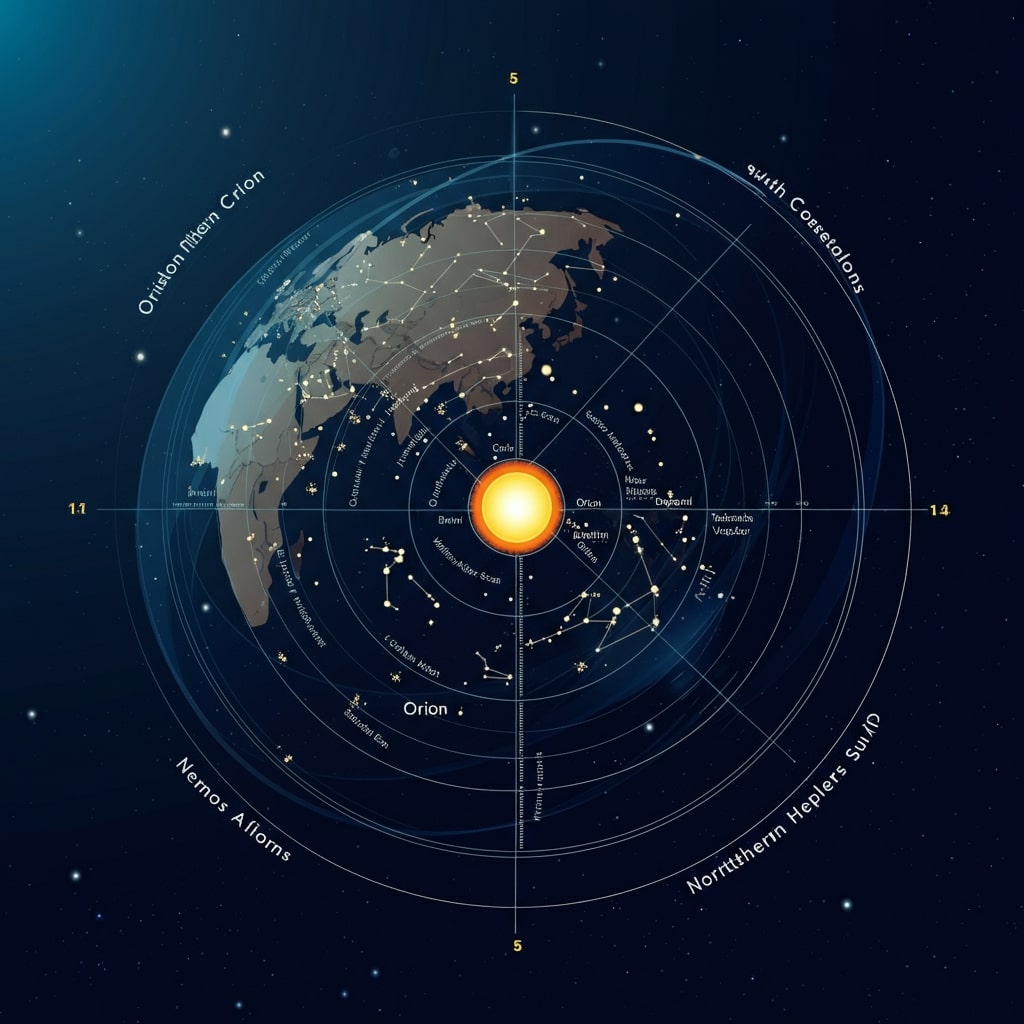
Stargazing can be one of the most awe-inspiring activities, connecting us to the vastness of the universe. However, many aspiring astronomers wonder why it isn’t possible to see all 88 officially recognized constellations in one night.
Are they hidden by obstacles? Is it a limitation of the human eye? The answer, as it turns out, is rooted in the fascinating movements of Earth and the interplay of location, time, and perspective.
This article will explore the core reasons behind this limitation, focusing on the Earth’s rotation, orbit, and latitude, alongside the differences between circumpolar and seasonal constellations. Finally, we’ll discuss how visibility varies across hemispheres.
By the end, you’ll not only understand why we can’t observe all constellations at once but also gain fresh insight into how to make the most of your stargazing experiences.
The Earth’s Movements and Their Effects on Stargazing
The main reason why not all 88 constellations are visible at the same time boils down to Earth’s unique motion through space. This includes its daily rotation on its axis, its yearly orbit around the Sun, and how its spherical shape affects your view of the sky.
1. Earth’s Rotation
Earth spins on its axis once every 24 hours. This rotation is why the Sun rises and sets each day—and the same principle applies to the stars and constellations. Just as half of Earth experiences daylight, only half of the celestial sphere (the imaginary dome of the night sky) is visible at any given time.
As Earth rotates from west to east, the stars appear to travel across the sky from east to west. Over the course of a single night, constellations that were near the horizon may rise higher, while others may set and disappear from view entirely. This constant motion only allows us to see part of the celestial dome during any one night.
2. Earth’s Orbit Around the Sun
While Earth’s rotation determines what we see on a nightly basis, its orbit around the Sun dictates what we see over the course of a year.
The constellations we observe at night lie on the side of Earth facing away from the Sun, meaning the Sun blocks our view of certain constellations during the day. For example, in winter, Earth faces a different portion of the celestial sphere at night compared to summer. As a result, constellations like Orion dominate the winter sky, while others, like Lyra and Cygnus, are prominent in the summer.
This shift happens because Earth’s field of view changes as it revolves around the Sun, effectively cycling through the constellations over the year. For stargazers, this means you need patience to see all visible constellations in annual cycles—not all at once.
The Role of Latitude in What You Can See
Latitude, or your location’s distance north or south of the equator, plays a significant role in determining which constellations are visible. Just as someone living near the poles has a vastly different climate than someone nearer the equator, their views of the night sky differ as well.
1. Circumpolar Constellations
Circumpolar constellations hold a special status in the sky. They are star patterns that never set below the horizon and are visible all year round. Which constellations qualify as circumpolar depends entirely on your latitude.
- Northern Hemisphere stargazers will recognize constellations like Ursa Major, Ursa Minor (home of Polaris, the North Star), Cassiopeia, and Cepheus. These constellations remain visible every night due to their constant proximity to the North Celestial Pole.
- Southern Hemisphere sky-watchers enjoy their own circumpolar constellations, such as Crux (the Southern Cross) and Carina.
The further you move toward the poles, the more circumpolar stars and constellations come into view, while fewer stars from the opposite hemisphere are visible. Conversely, at the equator, constellations rise and set more uniformly and few, if any, remain perpetually above the horizon.
2. Seasonal Constellations
Unlike circumpolar constellations, seasonal constellations are more fleeting. These are constellations that appear only during specific times of the year due to Earth’s orbit and position relative to the Sun.
For example, in the Northern Hemisphere, the summer night sky prominently features constellations like Hercules and Lyra. Meanwhile, winter nights are characterized by iconic constellations such as Orion, Gemini, and Taurus.
Northern Hemisphere vs Southern Hemisphere
The sky isn’t the same across the globe. The hemisphere you live in determines which constellations dominate the night sky.
Shared Views at the Tropics
People living near the equator have the unique advantage of observing constellations from both hemispheres. Certain constellations like Orion and Leo are on display in both the Northern and Southern Hemispheres but may appear oriented differently depending on your location.
Differences Away from the Equator
The further you move toward the poles, the more pronounced the differences become. Northern stargazers never see constellations exclusive to the Southern Hemisphere, like Crux or Centaurus. Conversely, Southern Hemisphere observers miss patterns such as Ursa Major or Cepheus.
Additionally, constellations visible in both hemispheres appear “upside down” when viewed from the opposite one.
Why Constellations Move Within the Night
If you’ve spent hours tracking stars, you’ll notice that the constellations themselves appear to move overnight. This movement is tied to Earth’s axial rotation. Each passing hour shifts stars closer to the horizon while others rise in their place, giving the impression of a celestial dance.
Circumpolar constellations, however, are special in their behavior. Instead of rising and setting, they trace circular paths around their respective celestial poles, remaining dependably present but changing orientation. For example, in the Northern Hemisphere, Ursa Minor (and the North Star) appears to rotate around Polaris over the night.
FAQs About Constellations and Stargazing
1. Why can’t we see all 88 constellations from one location?
Earth’s curved surface blocks half of the celestial sphere from view. Additionally, constellations are divided between the hemispheres, so Northern Hemisphere observers cannot see Southern Hemisphere constellations, and vice versa.
2. Do constellations disappear?
No, constellations do not disappear but become temporarily invisible due to Earth’s rotation and orbit. For instance, some constellations are blocked by the Sun during specific seasons.
3. Why are some constellations visible all year?
These are circumpolar constellations, which remain above the horizon throughout the year because of their proximity to the celestial poles.
4. How do constellations differ between hemispheres?
Certain constellations, like Crux in the Southern Hemisphere or Ursa Major in the Northern Hemisphere, are exclusive to one hemisphere due to their position relative to the equator.
5. Can you see constellations like Orion in both hemispheres?
Yes, Orion is visible from both hemispheres. However, it appears at different times of the year and is perceived “upside down” depending on your hemisphere.
6. Is stargazing better in one hemisphere over the other?
Not necessarily; each hemisphere offers unique constellations. Observers closer to the equator benefit from seeing constellations from both sides of the celestial sphere.
Final Thoughts
Although the limitation of seeing all 88 constellations at once may seem disappointing at first, this natural restriction makes stargazing all the more engaging. The Earth’s motion and the unique perspectives provided by different latitudes ensure there’s always something new to discover in the night sky, no matter where you are.
Understanding the Earth’s rotation, orbit, and how constellations are distributed across the hemispheres can deepen your appreciation for this ancient pastime. The next time you step outside to stargaze, remember that the constellations visible to you create a cosmic map that has guided humanity for centuries. The rest of the celestial wonders are still there, just waiting for the right time and place to reveal themselves.